Business Tips
How to Bid Commercial Landscape Maintenance Contracts
The first commercial RFP catches most owners off guard. A property manager asks you to bid the landscape maintenance contract on an office park, and the packet wants a certificate of insurance, references, a three-year price, and a number by Friday. You have priced hundreds of lawns. You have never priced anything like this.
This is a guide to bidding commercial landscape maintenance contracts from the ground up: where the work comes from, what belongs in the bid package, how to turn a site walk into hours and the hours into a defensible monthly price, and the part almost every bidding guide skips, which is what happens in years two and three after you win.
Why a commercial bid is a different animal than a residential quote
A homeowner spends their own money and decides in the driveway. A property manager spends a budget, answers to an owner or a board, and needs a paper trail showing the process was fair. That one difference drives everything else about how commercial grounds work is bought.
| Residential quote | Commercial bid | |
|---|---|---|
| Who decides | The homeowner | A property or facility manager, often with an owner or board above them |
| What they need | A number and a start date | Written scope, insurance certificates, references, a formal bid |
| How it is priced | Per visit or per month | An annual or multi-year contract, usually billed monthly |
| How you get paid | Due on receipt | Net 30 to net 60 against an invoice |
| How it ends | A text message | A term end, a renewal, or a re-bid |
Two rows deserve attention before you price anything. The insurance requirement usually means a certificate naming the property as additional insured, and your carrier may charge for the endorsement, so find out before the number is locked. And payment terms are a real cost: net 60 means you cover two months of payroll and fuel before the first check arrives, which is survivable only if you priced knowing it.
The work itself comes from property management companies, HOA boards, retail and office landlords, campuses, and public agencies. Public work is posted where anyone can see it: federal opportunities live on SAM.gov (opens in a new tab), and most states and municipalities run their own procurement portals. Private work moves earlier and quieter, usually among contractors the manager already knows. Getting onto that list is ordinary persistence: an introduction, an offer to walk the site, and being around when the incumbent stumbles. Our commercial grounds introduction letter is a reasonable first touch.
What a real bid package contains
RFPs vary, but a bid that gets taken seriously covers the same ground whether the property manager asked for all of it or not:
- Cover letter. One page, addressed to a person, naming the property, the term, and when you can start.
- Company overview. Who you are, how long you have operated, licensing, and proof of insurance.
- Scope of work by service line. Mowing with a frequency and a season, bed maintenance, pruning by season, treatment rounds, spring and fall cleanups, and snow if it is in scope. Every line gets a frequency, not an adjective.
- A service calendar. One page showing what happens in which month. This is the page managers forward to their boards.
- Pricing. The monthly number and the annual total, stated plainly.
- Exclusions and extra-work rates. What is not included, and what out-of-scope work costs per hour or per occurrence.
- Term and renewal language. How long, what happens at term end, and how either side exits.
- References. Two or three properties of similar size, with permission to call.
- Signature block. Make it possible to say yes on the spot.
The exclusions page is the one most contractors skip, and it is the page that protects you once the work starts. “Maintenance” expands quietly on a commercial property: storm branches, a bed a tenant wants replanted, ruts from a delivery truck. If the bid says what is included, everything else is billable extra work instead of a favor you cannot invoice.
Our landscape proposal template covers this structure for commercial and HOA work, and there are letter versions: an HOA community proposal and a commercial snow proposal if winter scope is on the table.
Measure the property with a wheel, not a guess
Commercial bids fail at the measuring stage more often than the math stage. The site is bigger than anything residential, the turf is broken into zones, and the difference between 70,000 and 90,000 square feet is invisible from the parking lot and very visible in your margin.
A free online mapping tool gives you a rough area from your desk, and that is a fine first pass for deciding whether to bid at all. The bid itself gets measured on site. Bring a measuring wheel, take photos of everything, and walk the whole property once before you measure anything.
What to capture on the walk:
- Mowable turf, in square feet, by zone
- Linear feet of edge along walks and curbs
- Bed square footage and current mulch condition
- Shrub and small tree counts, by rough size
- Surfaces in scope for snow, if any, in square feet
- Gates, bollards, and anything that forces a smaller machine
- Slopes, retention areas, and ground too wet to mow in spring
- Where the trailer parks, where debris goes, and how far the crew walks
The photos matter as much as the numbers. Six months in, when someone asks why bed work takes longer in one zone, the photo of the zone is the answer. The walk is also a sales tool: property managers notice which bidders actually walked the site, because most do not.
Production rates: turning measurements into hours
A commercial bid is a pile of hours wearing a price. The measurements become hours through production rates: how much turf your crew mows in an hour, how much bed area they can weed and detail, how long a cleanup takes on a property this size.
The only production rates worth using are your own. Time your crews for two or three weeks on properties you already service and you will have numbers no article can give you. Every figure below is an assumption for illustration. Substitute your own.
Take a small office park with these measured quantities:
| Measured on the walk | Quantity |
|---|---|
| Mowable turf | 85,000 sq ft |
| Beds | 6,000 sq ft |
| Mowing season | 28 weekly visits |
| Bed detail visits | 14, every other week |
| Cleanups | Spring and fall |
| Pruning | Two events per season |
And these assumed rates for a two-person crew:
| Service | Assumed rate | Hours |
|---|---|---|
| Mow, trim, blow | Crew covers 60,000 sq ft per on-site hour | 1.5 per visit |
| Bed weeding and detail | 6,000 sq ft per crew hour | 1.0 per visit |
| Spring cleanup, including spreading the mulch | Flat assumption | 12 |
| Fall cleanup | Flat assumption | 16 |
| Pruning | 4 crew hours per event | 8 per season |
At the assumed mowing rate, 85,000 square feet works out to 1.42 hours; call it 1.5 once the measured edge along the walks and curbs is trimmed in.
The season adds up like this:
| Service | Season hours |
|---|---|
| Mowing (28 × 1.5) | 42 |
| Bed detail (14 × 1.0) | 14 |
| Cleanups | 28 |
| Pruning | 8 |
| Total on-site crew hours | 92 |
Those 92 crew hours are the real product you are selling. Everything else in the bid is arithmetic on top of them, which is why timing your own crews matters more than any pricing formula. Get the hours wrong by 20% and no formula saves the bid.
Turning hours into dollars takes your cost per on-site hour, and we have already built one from scratch in our guide to what to charge for lawn mowing: wage, labor burden, billable hours per paid day, equipment, and overhead. We will borrow its worked-example numbers here, as assumptions like everything else.
Overhead recovery, margin, and the monthly number
From that worked example: loaded labor for the two-person crew runs $75.64 per on-site hour, and equipment, vehicle, fuel, and overhead together add $29.09. Materials get their own lines, priced from the walk: mulch by the yard, and a plant replacement allowance so a dead shrub is a line item instead of an argument.
| Line | Season total |
|---|---|
| Labor (92 hours × $75.64) | $6,959 |
| Equipment, vehicle, fuel, overhead (92 × $29.09) | $2,676 |
| Mulch (20 yards × $45 delivered) | $900 |
| Plant replacement allowance | $340 |
| Total season cost | $10,875 |
| Price at a 20% net margin | $13,594 |
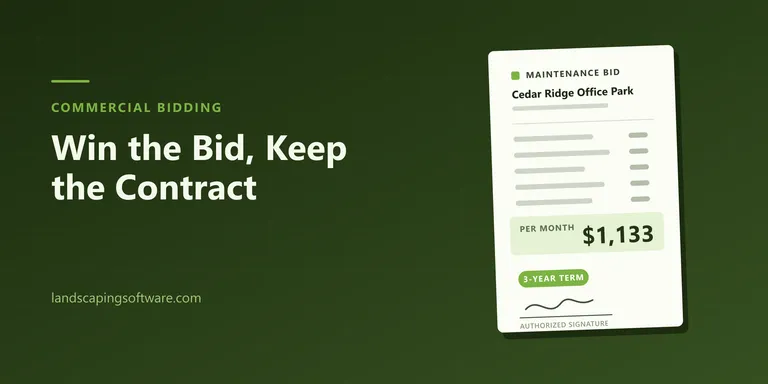
| The bid | $1,133 per month, $13,596 per year |
The bid row rounds the monthly up to a whole dollar, which is why the annual lands two dollars above the margin line. Take the two dollars.
Margin is a decision you make before the bid goes out, not whatever is left after the season. The mowing guide covers why your own pay is a cost line above margin rather than the leftovers below it, and the same discipline applies here, with more zeros.
The last decision is how the price gets billed, and it changes your winter more than your total:
- Twelve equal payments smooths revenue across the year and is what most property managers prefer to budget against. Your January invoice exists because the contract covers a year of grounds care, not a count of mows.
- Seasonal billing, April through November say, concentrates the same money into the months with payroll against them, and leaves winter dry.
- Per-visit billing on a base commercial contract makes every rained-out week a revenue event in the wrong direction. Keep it for extra work.
However the contract bills, the invoicing has to be boring and on time, because net 30 only starts counting when the invoice lands. Our invoicing and billing keeps it boring: monthly-fixed jobs generate their invoice at the start of each month, and per-visit work bills the moment it completes. What the invoice itself should contain, and the reminder cadence for when net 30 quietly becomes net 55, is covered in our landscape invoice template guide.
Seven bid mistakes that lose money quietly
- Pricing from the acreage. Two properties with the same lot size can carry wildly different mowable area, edge, and bed load. Price what you measured, not what the parcel map says.
- Bidding year one like there is no year two. Wages and fuel will not hold still for three years. A multi-year price with no escalation is a pay cut you signed voluntarily.
- Skipping the exclusions page. If the bid does not say what is out of scope, everything is in scope, at your expense, for the length of the term.
- Ignoring what net 60 costs. Slow payment terms are financing you are giving the property, interest free. Price them in, or negotiate them down.
- Buying the contract to get in the door. A below-cost year one only works if there is a written escalation path out of it. “We will fix it at renewal” is not a plan the customer agreed to.
- Not asking why it is out to bid. Sometimes the incumbent got expensive. Sometimes the property pays late, the scope creeps, or the last three contractors quit. Ask.
- Forgetting the quiet months still cost money. On twelve equal payments, winter invoices carry the season. On seasonal billing, they do not exist. Know which contract you signed before you spend the summer money.
The part nobody bids for: years two and three
Winning the bid is the expensive part. The profit is in keeping the contract, and almost nothing written about bidding covers what that takes. Commercial maintenance rewards incumbency: a property manager who already trusts you does not want to run another bid process, provided you give them no reason to.
Structure the term before you sign it
A one-year contract with renewal options and a true multi-year term look similar on the front page and behave differently in year two. Renewal options mean an annual conversation where the price can be reopened. A multi-year term with a built-in escalation means the price adjusts on schedule without a negotiation. If you can get it, take the multi-year term with a stated annual increase, either a fixed percentage or one tied to an inflation index, and decide that number when you bid rather than hoping for it later.
Expect to trade something for the commitment. Most managers will want an out clause, commonly 30 days written notice, and that is a fair trade: an escalating multi-year contract with an out clause is still worth far more than a series of one-year re-bids, because the default outcome flips from “prove yourself again” to “carry on.”
Snow makes terms interesting, because a winter season spans two calendar years and rarely lines up with the growing season. If snow is in scope, write the term dates around the full service year so neither side is ever renewing half a contract, and price the winter side deliberately; it is its own discipline, covered in our guide to snow removal contract pricing.
Document the extras from day one
Scope creep on a commercial property is structural rather than malicious: many tenants, one property manager, and every request funnels to the crew that happens to be on site. The defense was written back in the bid, on the exclusions page with the extra-work rates. The habit that makes it work is written authorization for anything outside scope, even when the answer is yes and the work is small.
Keep a running log of extras: the date, the request, who approved it, the hours, the amount. It keeps small work billable, and by renewal time it becomes something better: a record of everything you did beyond the contract, which is the strongest price-increase argument there is.
Renewal season is a sales season
Commercial budgets are set months before the season starts, which means the renewal is decided in the fall, not in the spring when the term actually ends. Book an end-of-season review with the property manager while the season is still visible on the ground: what was done, what the extras log says, what the property needs next year, and what the new price is. Our season review letter frames that meeting, and the price adjustment notice puts the increase in writing.
An increase communicated in October with reasons attached renews quietly. The same increase discovered on a January invoice starts a bid process.
The re-bid, and the advantage you built
Every commercial contract eventually goes back out to bid. Ownership changes, a board wants three quotes, policy requires it. The incumbent who measured the property, logged three years of service and extras, and showed up to season reviews is not bidding on the same terms as a stranger with a spreadsheet. Your service records are the one part of the package no competitor can copy, so keep them somewhere better than a notebook in the truck. Our buyer’s guide to landscaping CRM covers what that looks like.
What a bid template will not fix
It will not fix production rates you never measured. A polished package wrapped around guessed hours is a well-formatted way to lose money for three years. Time your crews first.
It will not rescue a bid priced below cost. If you won a contract that does not work, serve the term well and correct the price at renewal with the record to justify it. Walking away mid-term costs more than the margin you are missing.
It will not make a bad-fit property profitable. Some RFPs are structured for operations with regional crews and equipment you do not own. Losing those is not a failure. It is the exclusions page of your business.
It will not remember your renewal dates. The most common way to lose a commercial contract is not underbidding, it is silence: the term lapses, nobody scheduled the review, and the manager read the quiet as indifference. That is a workflow problem, and paperwork does not solve workflow.
Where we fit
You are reading this on a vendor’s blog, so here is the plain version.
Everything above works on paper. The bid math needs a calculator and honesty, and plenty of operators run commercial books in spreadsheets. What software changes is whether the years-two-and-three part actually happens, because that part is memory and timing, and both decay.
Our platform carries multi-year contracts that hold the term, the pricing model (per visit, per round, seasonal flat, monthly flat, time and materials, or T&M with a cap), and an annual price uplift from 0 to 50% written into the agreement. With auto-renew on, a nightly process watches the term: as the end approaches, the contract enters a renewing window, a renewal proposal is prepared for the customer, and once the window passes the term rolls forward with the uplift applied. For work not on a contract, the Renewal Wizard finds everything due in a window you set, up to a year ahead, and rolls it into the new season with line items copied and the increase applied, with a proposal PDF per customer if you want one. Customers who have not said yes stay on the reminders list, and a renewal-outcomes report shows what was accepted, declined, and still pending. Contracts and renewals ship on the Pro and Scale plans, and pricing is published.
What we do not have: property measurement tools (you will still walk the site with a wheel, which you should anyway), and no job-costing report comparing bid hours to actuals. If either is a dealbreaker, better to know now.
And if you hold one commercial account, you do not need software for any of this. A spreadsheet, a calendar reminder in September, and the discipline to keep the extras log will do. Come back when the third property manager starts assuming you will just remember.
Frequently asked questions
What should a commercial landscape maintenance bid include?
A complete bid package contains a cover letter, proof of licensing and insurance, a scope of work broken out by service line with frequencies, a service calendar, pricing with both monthly and annual figures, an exclusions list with rates for extra work, term and renewal language, references, and a signature block. The exclusions page is the one most contractors skip and the one that protects your margin once the work starts.
How do you price a commercial landscape maintenance contract?
Measure the property, convert the measurements into crew hours using production rates you have timed on your own crews, then run the season of hours through your loaded cost per hour. Add materials, then add a margin you choose before you bid rather than discover after. A copied price or a per-acre rule of thumb reflects someone else and their costs, not yours.
How long should a commercial landscaping contract run?
A single season proves the relationship, but multi-year terms are where maintenance contracts get valuable, because you stop re-bidding the same property every winter. If you sign a multi-year term, build in an annual price escalation so year three does not run on year one prices, and expect to trade a cancellation clause for the longer commitment.
When do commercial landscaping contracts go out to bid?
Most commercial properties budget months ahead of the season, so bids are commonly requested in late fall and winter for work that starts in spring. If you wait until the season starts to introduce yourself, the decisions are already made. The best time to get on a bid list is the season before you want the work.
How do you win commercial landscaping bids without being the lowest price?
Lowest price wins less often than contractors assume, because the property manager owns the result, not the savings. Bids win on a scope that shows you actually walked the property, a clean exclusions list that signals no surprise invoices, proof of insurance that makes their compliance job easy, and references from properties like theirs. Once you hold the contract, your service record becomes an advantage no outside bidder can copy.