Business Tips
How Much to Charge for Lawn Mowing
You priced that lawn at $45 because the last guy charged $40, and $45 felt like a raise. Two seasons later you are busier than you have ever been, the truck is paid for, and there is somehow no money in the account. Nothing went wrong. The price was just never built from anything.
This is a guide to setting mowing prices from your own numbers: what the market actually pays, how to work out your true cost per billable hour, and why the same lawn is worth two different prices depending on what you scheduled around it.
What the national numbers say
The most useful public dataset on mowing prices comes from LawnStarter’s 2025 pricing report (opens in a new tab), which covers more than two million completed mowing jobs across 2,000-plus US cities.
| Measure | 2025 figure |
|---|---|
| National average price per mow | $53.59 |
| Year over year change | +6.6% |
| Average per 1,000 sq ft | $6.38 |
| Highest state average | Vermont, $78.15 |
| Lowest state average | Arizona, $45.08 |
| Northeast average | $58.17 |
| West average | $50.90 |
| Peak season (August) vs January | $54.66 vs $49.28 |
Two things are worth saying about that table honestly. It reflects work booked through a lawn care marketplace, and platform-brokered jobs are not always priced the way work you sell directly gets priced. And a national average blends a quarter-acre suburban lot with a postage stamp in a dense city, which means it describes the market without describing any actual lawn.
Use it the way you would use a weather forecast for a state. It tells you roughly what climate you are operating in. It does not tell you whether to wear a jacket today.
Why a copied price will not hold
Every price you inherit from a competitor carries their cost structure, not yours. They may run a two-person crew where you run three. They may have an older truck with no payment and higher repair bills, or a newer one with the reverse. Their insurance, their fuel, their drive time, and their pay scale are all different from yours.
Copying the number gets you their price with your costs. That works right up until the season your costs move and theirs do not.
The alternative takes about twenty minutes with a calculator, and it survives every year after that because it is built from inputs you can update.
Build the price from your own costs
Step 1: your true labor cost per hour
Start with the wage, then add what it actually costs to employ someone. The federal Occupational Outlook Handbook (opens in a new tab) puts the median wage for grounds maintenance workers at $18.50 an hour as of May 2024, with the bottom tenth under $14.49 and the top tenth above $27.14. Your local market may sit well outside that.
On top of the wage sits labor burden: employer payroll taxes (roughly 7.65% for Social Security and Medicare, plus federal and state unemployment), workers’ compensation, and any benefits or paid time you offer. Workers’ comp is the line that makes landscaping different from an office trade, and it varies enormously by state and by your own claims history.
Burden commonly lands somewhere between 25% and 40% above base wage for this kind of work. Get your real number from your payroll provider and your comp policy rather than trusting a range from the internet, including this one.
Step 2: the hours you can actually bill
This is the step almost everyone skips, and it is the one that decides whether the rest of the math means anything.
You pay a crew for eight hours. They do not mow for eight hours. They load, they drive to the first stop, they drive between stops, they fuel, they unload, they take breaks, they drive back. The hours that generate revenue are the hours the mower is moving on a customer’s turf.
If a crew is paid for eight hours and puts five and a half of them on the ground, your entire daily cost has to be recovered across five and a half hours, not eight. Divide by the wrong number and every price you set afterward is too low by a third.
Step 3: equipment, fuel, and overhead
Two buckets. Equipment and vehicle covers the truck and trailer payments or depreciation, fuel, maintenance, blades, and mower replacement reserve. Overhead covers everything that exists whether or not you mow today: general liability, phone, software, accounting, marketing, licensing, and the hours you spend quoting and invoicing.
Total each bucket annually, divide by the number of crew days you actually run in a season, and you have a per crew day figure you can push through the same billable hour divisor.
Step 4: the margin you actually want
Margin is not what is left over. It is a number you decide before you quote, and your own pay is a cost line above it, not the leftovers below it. Many maintenance operations target something in the 10% to 20% net range after every cost, including a real wage for the owner.
The worked example
Every figure below is an assumption for illustration. Substitute your own.
| Input | Assumption |
|---|---|
| Base wage | $20.00 / hour |
| Labor burden | 30% |
| Loaded wage | $26.00 / hour |
| Crew size | 2 |
| Paid hours per day | 8 |
| Billable (on the ground) hours per day | 5.5 |
| Equipment, vehicle and fuel | $90 / crew day |
| Overhead allocation | $70 / crew day |
| Target net margin | 20% |
Running it through:
| Line | Per crew day | Per billable hour |
|---|---|---|
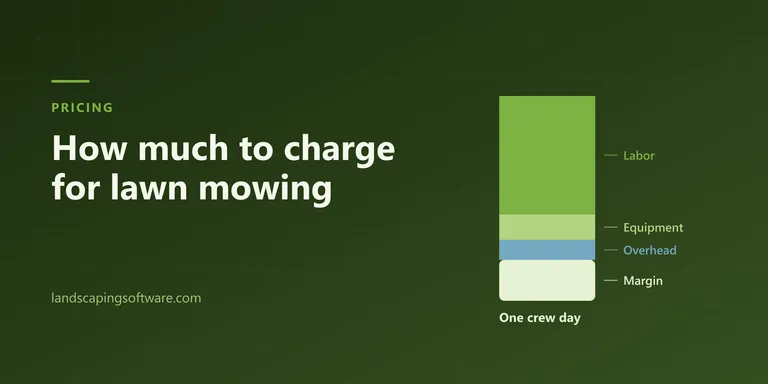
| Labor (2 × 8 × $26.00) | $416.00 | $75.64 |
| Equipment, vehicle, fuel | $90.00 | $16.36 |
| Overhead | $70.00 | $12.73 |
| Total cost | $576.00 | $104.73 |
| Price at 20% net margin | $130.91 |
So this crew needs roughly $131 for every hour the mower is actually running. Which prices out like this:
| On-site time | Price |
|---|---|
| 20 minutes | $43.64 |
| 25 minutes | $54.55 |
| 30 minutes | $65.45 |
| 45 minutes | $98.18 |
A 25 minute lawn lands at $54.55, within a dollar of the national average. That is not a coincidence so much as a reassurance: when you build the number from the ground up, you tend to arrive near where a functioning market already is. The difference is that now you know why, and you know exactly which input to change when diesel or wages move.
Pricing by measurement
Once you have a rate per billable hour, you still need a repeatable way to estimate how long a property takes. Measured area is the most consistent input available, which is why per 1,000 square feet pricing has become common. The 2025 national average worked out to $6.38 per 1,000 square feet.
Measure the mowable turf, not the lot. A half-acre lot with a house, a driveway, a pool, and beds might hold 8,000 square feet of grass. Pricing off the lot size overcharges, and losing the bid teaches you nothing about why.
Then adjust for what square footage cannot see: trim line and obstacles, gates that force the walk-behind, slopes, and the distance from where the trailer can legally park. Two properties with identical turf area routinely differ by ten minutes for these reasons alone.
Per acre pricing deserves a narrower role than it usually gets. It works for open uninterrupted turf, and it falls apart on residential work where an acre may be broken into a dozen small obstructed sections.
If you want a consistent starting structure for quotes, our landscaping estimate template lays out the line items to capture.
Route density is a pricing decision
Here is the part most pricing advice leaves out, and it is the single largest lever in this article.
Your billable hour divisor is not a fact about your business. It is a consequence of how you built the route. Tighten the stops and more of the paid day becomes billable. Scatter them and the same crew, the same wage, and the same mowers produce a materially different cost per hour.
Take the crew from the worked example and change nothing except drive time.
| Dense route | Scattered route | |
|---|---|---|
| Paid hours | 8.0 | 8.0 |
| Billable hours | 5.5 | 4.0 |
| Total daily cost | $576.00 | $576.00 |
| Cost per billable hour | $104.73 | $144.00 |
| Price at 20% margin | $130.91 | $180.00 |
| Price of a 25 minute lawn | $54.55 | $75.00 |
Same lawn. Same crew. Same equipment. A 37% difference in what it has to be worth, decided entirely by what got scheduled around it.
This cuts both ways, and the second direction is the useful one. A lawn you would have declined at $50 becomes comfortably profitable if it sits between two stops you were already making. A lawn that pays $70 can lose money if it is a solo run across town. The right question at quoting time is never “what is this lawn worth,” it is “what is this lawn worth on the day it will actually be mowed.”
Which means density is worth protecting deliberately: cluster new customers into existing routes, be honest about the cost of a one-off outlier, and rebuild the day when the pattern degrades. If you want the mechanics of holding routes together across a season, that is what our scheduling and routing is built to do, and our guide to scheduling landscaping crews walks the same crew through a route day, a capacity check, and a rain day.
Per visit, monthly, or per season
Price and billing model are separate decisions, and the second one changes your cash flow more than the first.
| Model | How it works | Suits |
|---|---|---|
| Per visit | Invoice each completed cut | Variable frequency, new customers, weather-dependent regions |
| Monthly fixed | Same invoice each month regardless of visit count | Established recurring accounts, predictable cash flow |
| Per round | One invoice when a treatment round completes | Fertilization and program work |
| Seasonal prepay | Billed up front for the season | Strong customer relationships, front-loaded cash |
Monthly fixed is the one worth thinking hardest about. It smooths your revenue and the customer’s budget, and it stops the awkward conversation about a short month. It also means a rained-out week does not cost you the invoice, provided the contract is written around a season of service rather than a count of visits.
The catch is that it only works if you know your real annual visit count per property, which loops straight back to the cost math above. Our invoicing and billing supports all four models per job, so different jobs for the same customer can bill differently.
Winter flips the same table: per push is per visit in a plow truck, and a seasonal snow contract is monthly fixed with the weather risk priced in. That arithmetic is different enough to get its own guide, with ten years of plowable-day data behind it: snow removal contract pricing.
Whichever model a job uses, the document that lands in the customer’s inbox is its own craft. What belongs on it, the terms that get it paid, and what to do when it goes quiet are covered in our guide to invoicing landscaping customers.
Raising prices without losing customers
Costs go up every year. Prices that do not are a slow decision to earn less.
Small annual increases work. A 4% to 6% adjustment applied at renewal is absorbed by most customers with no conversation at all, and it compounds in your favour. A 20% correction after three flat years reads as a shock, and it is the one that triggers cancellations.
Three things make it land. Give notice in writing before the season starts, not with the first higher invoice. State the new price plainly without a paragraph of apology, because apologizing invites negotiation. And apply it across the board rather than to the customers you think will tolerate it, which is how price lists fragment into chaos.
Our full guide to raising prices on existing lawn care customers works through the break-even math and includes three copy-and-paste letters, and we also publish a price adjustment letter you can send as-is, and auto-renewing contracts with a built-in uplift so next season’s increase applies itself rather than depending on you remembering.
Six signs your price is too low
- You are booked solid and your bank balance is flat.
- You cannot remember the last time you raised a price on an existing customer.
- Every quote you send gets accepted, immediately, with no questions.
- Your own pay is whatever is left at the end of the month.
- You have taken on properties well outside your route because the number sounded acceptable in isolation.
- A machine breaking is a crisis rather than an expense.
The counter-test: if you are turning down roughly one quote in four on price, and the ones you win cover a real wage for yourself plus a margin on top, your pricing is probably about right. Winning everything is not a sign of good pricing.
What better pricing will not fix
It will not fix a route that does not work. The math above will tell you what a scattered route costs. It will not tighten it for you.
It will not make an underquoted contract profitable. If you signed a season at a number that does not work, you finish it and you reprice at renewal. Repricing mid-season damages a relationship for one year of partial recovery.
It will not win you a bid you should lose. Some properties are priced by someone with lower costs, or by someone who has not done this arithmetic and will find out in two years. Losing to the second one is fine. Commercial work runs the same arithmetic at a larger scale, with a contract on top; our guide to bidding commercial landscape maintenance contracts walks through it.
It will not survive without measurement. Every number here depends on knowing your real billable hours, your real annual crew days, and what each property actually took. Those decay fast in memory, which is the same argument for keeping customer and property records somewhere other than your head. Guessing the inputs produces a confident price built on fiction.
Where we fit
You are reading this on a vendor’s blog, so here is the plain version.
The pricing method above works on paper regardless of what software you run, and plenty of operators do it in a spreadsheet. What software changes is whether the inputs stay true. Billable hours, visits actually completed per property, which jobs got invoiced, and what a route looked like on the day are all things that decay fast when they live in memory.
Our lawn care platform tracks the recurring visit through to the invoice, supports per visit, monthly, per round, and prepay billing on the same customer, and handles the route side: drive-order optimization, memorized route templates you reapply each week, and a capacity check before you add one more stop to a day. Renewals can carry an automatic price uplift so the annual increase is not a task you have to remember. Pricing is published, with no per-payment platform fee, because you connect your own Stripe account.
What we do not have: two-way texting with customers. If that is a must-have for you today, it is worth knowing before you spend a week on a trial.
And if you are a solo operator with thirty lawns, you do not need any of this yet. Do the arithmetic in a spreadsheet, protect your route density, and raise your prices every spring. Come back when a second crew makes the spreadsheet start lying to you.
Frequently asked questions
How much should I charge to mow a lawn?
The national average price per mow was $53.59 in 2025, according to LawnStarter’s analysis of more than two million completed jobs. Treat that as a sanity check, not a rate. What you should charge depends on your loaded labor cost, how many hours of your paid day are actually billable, your equipment and overhead, and the margin you need. A 25 minute lawn on a tight route and the same lawn twenty minutes across town are not the same job.
How do you calculate lawn care pricing per square foot?
Divide your price by the mowable area in thousands of square feet. The 2025 national average was $6.38 per 1,000 square feet. Measuring beats eyeballing because it prices the turf you actually cut rather than the lot size, and it makes quotes consistent between whoever is writing them. Add for obstacles, slopes, and gates, because those cost time that square footage alone does not capture.
Should I charge hourly or per job?
Quote per job, but price it from an hourly cost. Customers want a number they can budget against, and hourly quotes punish you for getting faster. Work out your cost per billable hour, add your margin, then multiply by how long the property actually takes. Bill hourly only for work you cannot scope in advance, like storm cleanup or overgrown first cuts.
How much should I charge per acre to mow?
Per acre pricing works for open, uninterrupted turf and breaks down everywhere else. An acre of open field mows in a fraction of the time an acre of fenced, landscaped, tree dotted residential property does, on the same machine. If you use a per acre rate, keep it for large open properties and price smaller residential work per 1,000 square feet or per property.
What is a good profit margin for lawn care?
Set a target net margin before you quote rather than discovering your margin at year end. Many maintenance operations aim for something in the range of 10 to 20 percent net after all costs including your own pay. The important discipline is that your own wage is a cost line in the calculation, not whatever happens to be left over.
How often should I raise my lawn care prices?
Review pricing every season rather than waiting for a year when costs jump. Small annual increases applied at renewal are absorbed far better than a large correction after three flat years. Give notice in writing before the season starts, state the new price plainly, and do not apologize for it.