How to Manage Daily Routes (Route Management)
Last updated July 6, 2026 · Admins, office staff, and crew managers
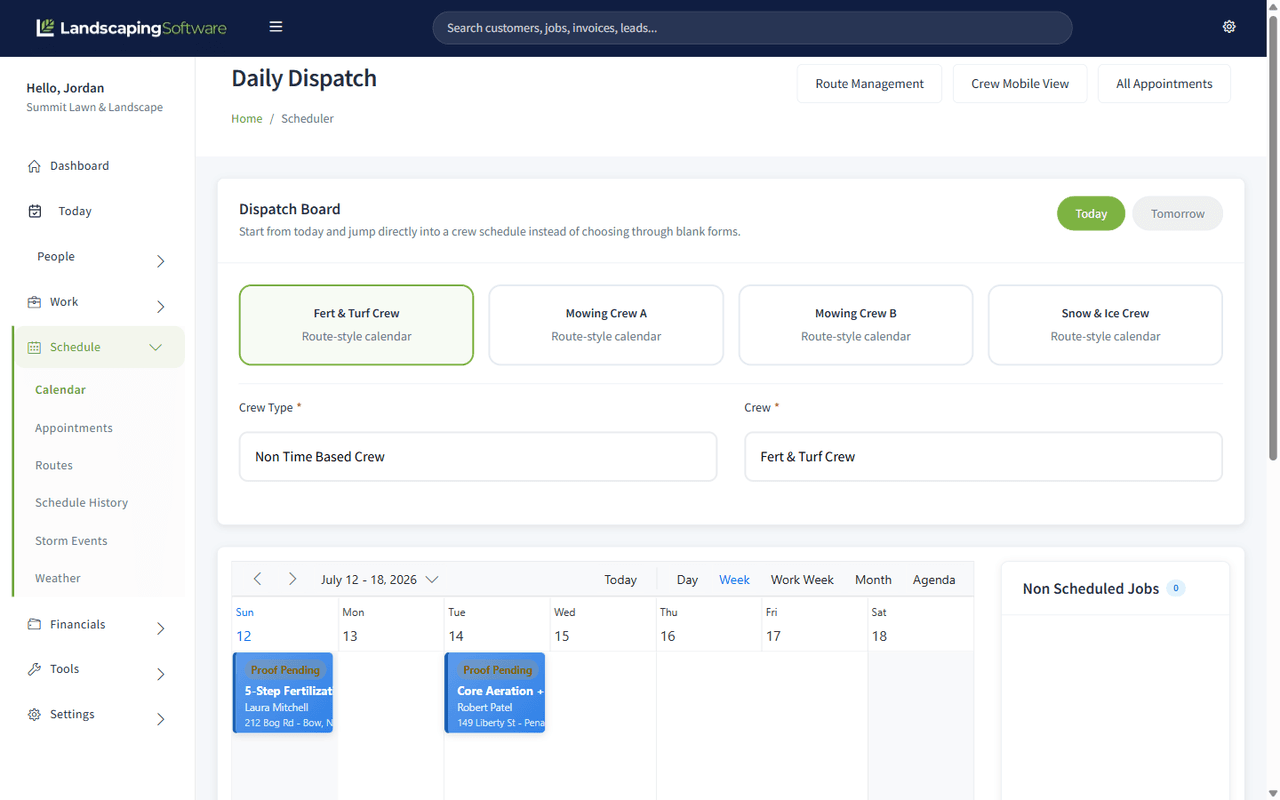
The Route Management page is the planner for route-style (non-time-based) crews. Load a crew’s day and you get the stop list in order — reorder it by hand, let the optimizer order it for you, save a favorite order as a reusable template, sanity-check the day against crew capacity, and shift a whole route when rain pushes everything back. Open it from the Route Management button on Daily Dispatch.
Before you start
- Route Management works with non-time-based crews only (crews whose Time Based setting is No). Time-based crews are managed on the calendar and won’t appear in this page’s Crew dropdown.
- Visits must already be scheduled on the date you want to plan — create them first (see Calendar Scheduling).
- Set the crew’s depot address. The crew’s Address/City/State/Zip on its crew page is used as the route’s start/finish point. Without it, the page shows “No depot configured for this crew” with a link to fix it, and the optimizer falls back to a simpler ordering.
Load a route
- Go to Scheduler → Route Management.
- In the Filter card, pick the Date (defaults to today, mm/dd/yyyy) and the Crew, then click Load Route.
- The day’s stops appear as cards under Non Time Based Crew Jobs. Each card shows the job name, customer, address, and a Stop # badge (or “Not ordered” if the visit has never been given a position).
- Above the list, the Depot Start / Finish card shows the crew’s depot address and crew name.
Reorder stops by hand
- Drag a stop card by its handle, or use the up/down arrow buttons on each card, to change its position. The Stop # badges renumber as you go.
- Reordering on screen is not saved yet — click Save Route (top right of the stop list) to persist the order. You’ll see “The route has been saved successfully.”
Optimize the route automatically
- Load the route.
- (Optional) Untick “Return crew to depot after final stop” if the crew ends its day at the last property instead of driving back.
- Click Optimize Route.
- The stops reorder into the suggested driving order. The confirmation tells you which engine ran:
- “Route optimized with Azure Maps” — real drive-distance optimization (requires the mapping service to be configured for your account and a depot address on the crew).
- “Route reordered using the fallback optimizer” — a simpler ordering used when mapping isn’t available.
Memorize a route (save as template)
When a day’s order is the one you want to reuse every week:
- Load the route and get the stops in your preferred order.
- Click Memorize Route, give it a name (it suggests “Crew name Route”), and confirm.
- You’ll see “Route template saved.” and it appears in the Memorized Route dropdown.
Templates are tied to the crew, so the dropdown shows the selected crew’s saved routes (click Refresh Templates if you’ve just added one).
Apply a memorized route
- Load the crew’s route for the date you’re planning.
- Pick the template from the Memorized Route dropdown and click Apply Template.
- The day’s stops rearrange to match the memorized order (stops that weren’t in the template drop to the end). Click Save Route to lock in exactly the order shown.
This is the weekly workflow for recurring routes: load Tuesday, apply “Tuesday North Route”, save, done.
Check capacity
Click Check Capacity after loading a route to see whether the day fits: the message shows total estimated hours vs. the crew’s capacity and warns if the route is over. The check assumes an 8-hour crew day. Use it before adding “just one more stop” to a full day.
Rain / Delay Shift (batch reschedule)
When weather wipes out a day, shift the crew’s whole schedule instead of dragging visits one by one:
- Select the crew (the date doesn’t matter for this tool) and click Rain / Delay Shift.
- In the modal, enter Shift by (days) — positive moves work later, negative moves it earlier. Zero isn’t allowed.
- Click Preview. The modal tells you exactly what will move, e.g. “This will move 27 visit(s) currently scheduled between 07/06/2026 and 07/18/2026 by 1 day(s).” The Shift Visits button stays disabled until a preview has run (and re-disables if you change the day count).
- Click Shift Visits to commit. You’ll see how many visits moved — then reload the route to review.
Important — read before you click: the shift moves every open visit for that crew on every date, not just the day you loaded. Completed and skipped visits stay put, and recurring series never move (reschedule those from the calendar).
What happens next
- The saved stop order is what crews see: stop numbers flow through to the crew’s day view and the Route # column in the All Appointments grid.
- Every reorder, optimization, template apply, and batch shift is written to the schedule change history, so you can trace why a stop moved.
Tips & best practices
- Set every route crew’s depot address first — it unlocks real drive-order optimization and the Depot card sanity check.
- Optimize once, then memorize. Let the optimizer find the efficient loop, tweak it with local knowledge, then save it as a template so you never re-solve the same puzzle.
- Preview is your friend on Rain Shift. The visit count and date span tell you instantly if you’re about to move more than you meant to.
- Run Check Capacity whenever you add stops to an existing route day.
Troubleshooting
- My crew isn’t in the Crew dropdown — the crew is time-based (Time Based = Yes) or inactive. Only active, non-time-based crews are routed here.
- “No jobs found on given search criteria!” — no visits are scheduled for that crew on that date. Check the date, or schedule visits first.
- “No depot configured for this crew” — add Address, City, State, and Zip on the crew’s page (the warning includes a direct link).
- Stops say “Not ordered” — those visits have never been given a stop number. Reorder (or just click Save Route) to number them.
- “Route reordered using the fallback optimizer” — the mapping service isn’t configured or the crew has no depot address; the order is a best-effort guess rather than drive-distance optimized.
- Rain Shift says “No open visits would move” — everything for that crew is completed, skipped, or recurring (recurring series are excluded by design).
- “Load a route before saving/optimizing” — click Load Route first; the tools act on the currently loaded stop list.
Related articles
- Scheduling Overview — time-based vs route-style crews
- Calendar Scheduling — creating the visits that appear on routes
- Visit Actions — completing visits, bulk status updates
- Manage Crews — set the depot address and Time Based flag