Manage Your Products & Services Catalog (Products)
Last updated October 16, 2026 · Admins and office staff
Your Products & Services catalog is the reusable price list you draw from everywhere else in the app. Once an item is in the catalog, you can drop it onto jobs, estimates, and invoices without re-typing its name and price. This article covers listing, creating and editing catalog items, and how they flow onto the documents you bill from.
Before you start
- Open the catalog from Billing > Products & Services in the sidebar.
- Decide whether each item is a Service (labor: mowing, aeration, a fert round) or a Product (a physical good you resell). It’s the only type distinction the catalog makes, and it’s used for badges and filtering.
- Know your Unit Price (what you charge) and, optionally, Unit Cost (what it costs you).
Steps
View the catalog
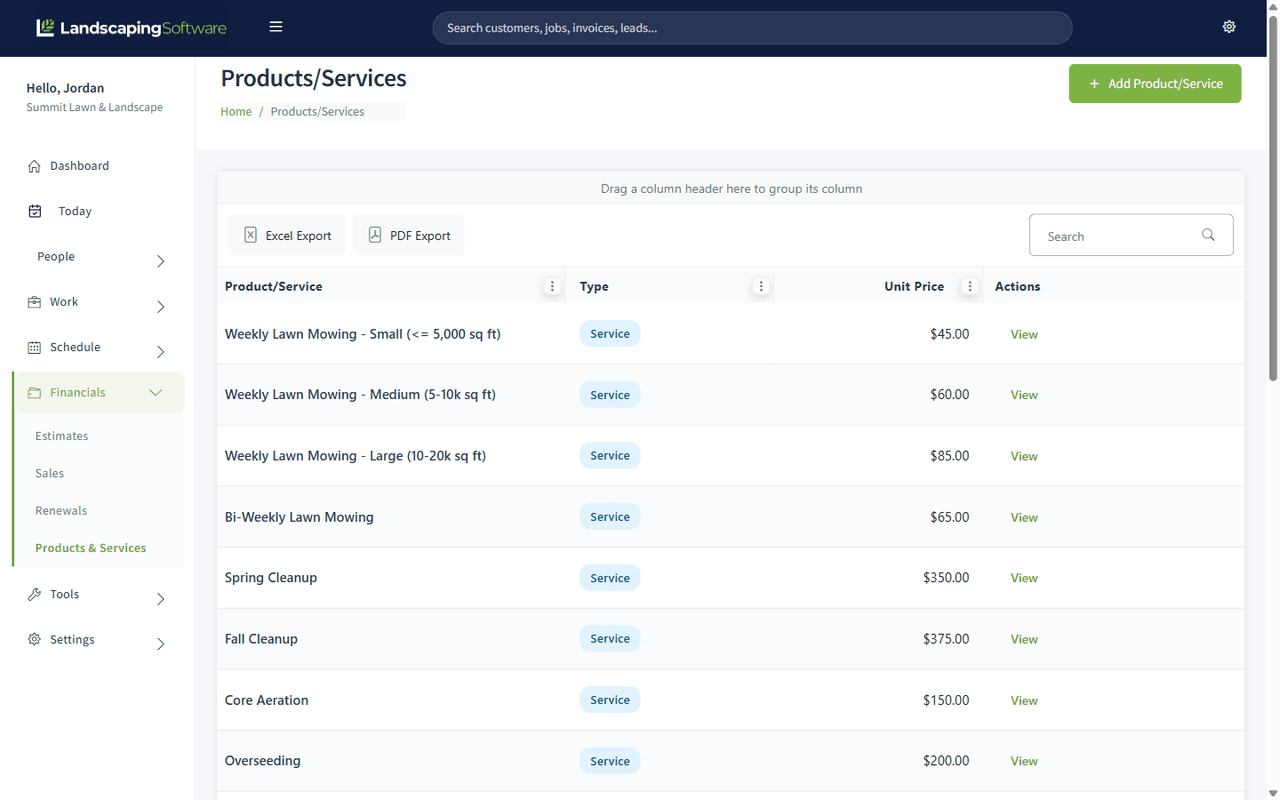
- Go to Billing > Products & Services. The grid lists every item with its Product/Service name, Type (Service or Product badge), and Unit Price. Description and Unit Cost are available as hidden columns.
- Use the grid’s Search box to find an item, and the column menus to sort and filter. You can export the list to Excel, PDF, or CSV from the toolbar.
- Click an item’s name (or its View button) to open its details page.
Create a product or service
- On the catalog page, click Add Product/Service.
- Fill in the form:
- Name (required): what the item is called on documents. Up to 225 characters.
- Description: optional detail.
- Type: choose Service or Product (you must pick one; “Select…” is not a valid choice).
- Unit Cost: your cost, defaults to 0.00.
- Unit Price: what you charge, defaults to 0.00.
- Priced per: the unit the price is for, such as Each, Per 1,000 sq ft or Per hour.
- Taxable: turn this on to charge sales tax on this item. Leave it off for items you don’t tax.
- If your plan includes Property Maps, you also see Auto-measure from map, Production rate and Crew map layers. See Pricing from Measurements.
- Click Submit.
Edit a product or service
- Open the item from the catalog.
- On its details page, change the Name, Type, Description, Unit Cost, Unit Price, Priced per, the map fields, or the Taxable toggle.
- Click Save Changes.
Editing the catalog item changes its default price going forward. It does not rewrite prices already saved onto existing jobs, estimates, or invoices; those keep whatever rate was on them when they were added.
Limits on names and prices
| Rule | Message you see |
|---|---|
| Name is required | “Product/service name is required.” |
| Name is at most 225 characters | “The name can be at most 225 characters.” |
| Prices are whole cents (no third decimal) | “Unit cost and unit price can have at most two decimals.” |
| Prices cannot be negative | “Unit cost and unit price cannot be negative.” |
| Prices are at most $999,999.99 | “Unit cost and unit price can be at most $999,999.99.” |
| Production rate is 0 or more | “The production rate must be between 0 and 9,999,999,999.99.” |
The price limit matches the largest amount an invoice line can hold, so anything you can put in the catalog can be billed.
Two items with the same name
You can save an item with the same name as one you already have (for example the same service priced two ways). It saves, and you see a Heads up banner telling you there are now two with that name. Because they look the same in lists and pickers, rename one if they are hard to tell apart.
Field reference
| Field | Required | Notes |
|---|---|---|
| Name | Yes | The item’s name on documents. Up to 225 characters. |
| Description | No | Optional detail. |
| Type | Yes | Service or Product. Drives the Type badge. |
| Unit Cost | No | Defaults to 0.00. 0 to $999,999.99, whole cents. Stored for your reference, never billed. |
| Unit Price | No | Defaults to 0.00. 0 to $999,999.99, whole cents. The default rate that flows onto documents. |
| Priced per | No | The rate basis. Defaults to Each. |
| Taxable | No | On means sales tax is charged on this item. |
How products flow onto jobs, estimates, and invoices
The catalog is the shared source for line items across the app:
- On a job: in the Job Summary’s Product/Services tab, click Add Product/Service and pick a catalog item. Its Unit Price fills the line’s Rate; you set Quantity and can adjust the Rate per job. See Job Summary: Managing Products & Services.
- On an estimate: you build estimate line items from the same catalog when quoting work.
- On an invoice: invoices draw their line items the same way, whether you create them by hand or the job’s automatic invoicing creates them for you.
Because line items copy the price at the moment you add them, you can safely raise a catalog price later without disturbing quotes and invoices you’ve already sent.
What happens next
- After Submit, the new item opens on its details page with “Product/service created successfully!” (or the Heads up banner for a repeated name), and is immediately available in the pickers on jobs, estimates, and invoices. If you added it on the way to something else, such as from a job’s price lines or Add work, you go back to where you were instead.
- After Save Changes, you stay on the details page with the updated values. If a value breaks one of the limits above, nothing is saved and the message shows at the top of the page.
Tips & best practices
- Set the Type correctly. Service vs. Product drives the badge and makes filtering your catalog useful as it grows.
- Keep Unit Price current rather than editing each line item. Catalog changes flow onto future line items automatically.
- Check the Taxable toggle on every item. It decides whether sales tax is added when the item is billed.
- Name items the way they should read to customers, since the name appears directly on estimates and invoices.
Troubleshooting
- “Select a product/service type.”: you left Type on “Select…”; choose Service or Product.
- One of the limit messages above: correct the value and save again.
- “The selected product/service could not be found.”: the link is stale; go back to the catalog list and open the item again.
- I want to remove an item I no longer sell: there is no delete button on the catalog list or the details page. Rename it (for example add “Retired” to the name) so nobody picks it by mistake.
- An item isn’t showing in a job or estimate picker: confirm it was saved (it appears in the catalog list); the pickers read the same catalog.